I have just returned from the Software Developer Conference (SDC) in Arnhem. My area of interest was DotNetNuke (DNN) the open source CMS and web application framework for the Microsoft environment. An entire conference within a conference, (DNN Open Force 07) was planned.
Although I no longer develop I have recently used DNN to deploy a number of corporate websites. Readers of this blog will know that my focus of interest is the intranet and enterprise 2.0. My experience of DNN had taught me that it has huge potential for use inside the firewall for corporate intranet/extranet apps but that the social tools were rather weak and underdeveloped. I wanted to hear from the core DNN team, whether 2.0 was on their radar?
I was not disappointed! Shaun Walker’s (DNN’s dynamic founder and CEO) keynote bristled with references to the social tools he was determined to bring to the core product. The topic also came up in break-out sessions by Salar Golestanian, Stefan Kamphuis.
Blog Platform
I gathered from later sessions that plans for a blogging platform module “as good as any out there” were well advanced and perhaps we would see this within six to twelve months.
Although the blog platform tool market on the consumer web is more or less sewn up by the likes of Typepad, Google Blogger and others (therefore the barrier to entry is huge) I see a significant niche market within the firewall.
Forward thinking intranet managers are crying out for a economical business blog platform that can be easily integrated with core intranet facilities like authentication and notification. If DNN get it right (provide the essential features and also the permissioning tools to allow the intranet manager to balance workforce self-organising with an element of control for both employee and customer blogging) they will be on to a winner.
I am considering offering my services to help them with their requirements definition.
Tomorrow I will post about the possibilities for an enterprise wiki within DNN.
All comments welcome.
Thursday, September 20, 2007


Thursday, September 13, 2007
Reinvigorate that legacy intranet
- A recent post by by Stewart Madder on the Atlassian blog prompted me to explain how I believe an enterprise wiki can be used to re-invigorate a legacy intranet.
Typically, the intranet tools which are in use today have somewhat clumsy publishing processes. There is a form to fill out with half a dozen fields (categories / sub-categories, Title, expiry, attachment and a few more) Some of them even have an approval/authorization process and other impose a conversion routine where word attachments are converted to HTML. Information is usually categorized via a taxonomy and it exists in silos that mirror the companies’ organizational structure.
Thos who know wikis will appreciate the magical qualities they bring to content management, some of which are.
- Incredible ease of publishing
- Anyone can publish / anyone can read
- There is no clear content owner. This reduces the feeling of intimidation thereby encourages others to pitch-in and improve the text.
- The tags (labels) provide for a folksonomy and a way for one piece of information to be categorized in many ways thereby enhancing discovery.
- Notification: Advanced enterprise strength wikis like Confluence have sophisticated “watch” tools that provide both email and (spam/virus free) RSS notifications of new and changed content.
It is my hope that the workforce will create new documents within the wiki that reference, via hyperlinks somewhat more formal documents that exist within the traditional intranet thereby driving traffic to and reinvigorating the legacy intranet content (or the sub-set of that content that the workforce decide is still relevant/useful.
As part of a future phase I would like to investigate Atlassian’s social book marking plug-in to see if this can be used to boost this effect.
Friday, September 7, 2007
Quechup Sucks!
I am very angry.
Yesterday I went through every contact in my Gmail account and inserted spurious characters into each email address. I then cancelled my membership at Quechup.
This morning at around 06:00 Quechup spammed everyone in my address book using the email addresses as they were when I signed up last Tuesday.
I implore all of you in the Blogosphere to get the word out regarding the shameful behaviour of this "service"
Yesterday I went through every contact in my Gmail account and inserted spurious characters into each email address. I then cancelled my membership at Quechup.
This morning at around 06:00 Quechup spammed everyone in my address book using the email addresses as they were when I signed up last Tuesday.
I implore all of you in the Blogosphere to get the word out regarding the shameful behaviour of this "service"
Thursday, September 6, 2007
A public letter to Quechup
I have canceled my account with Quechup. The cancellation process gave one the opportunity to give a reason. I reproduce my response below as an open letter to the Quechup operators.
----------
I heard of outrageous and unacceptable behavior of your site/software re: spamming. I have read many reports of your software spamming every person in one's mailbox without first requesting permission!
I trusted your site with my Gmail password and elected not to email any of my contacts. I will be most annoyed if you spam them after I resign (as I have heard has happened to others)
I have blogged about this unacceptable behavior and advised everyone to stay away from your site. You have made a lot of people out here very angry with you. I suggest immediate cessation of the spamming and a public apology. Do not underestimate the power of the blogosphere to negatively or indeed positively impact your business!
You claim to be a social network is in my opinion rather unbelievable too. In my opinion you are a front for the iDate dating outfit!
Alek Lotoczko
lotocz@gmail.com
----------
I heard of outrageous and unacceptable behavior of your site/software re: spamming. I have read many reports of your software spamming every person in one's mailbox without first requesting permission!
I trusted your site with my Gmail password and elected not to email any of my contacts. I will be most annoyed if you spam them after I resign (as I have heard has happened to others)
I have blogged about this unacceptable behavior and advised everyone to stay away from your site. You have made a lot of people out here very angry with you. I suggest immediate cessation of the spamming and a public apology. Do not underestimate the power of the blogosphere to negatively or indeed positively impact your business!
You claim to be a social network is in my opinion rather unbelievable too. In my opinion you are a front for the iDate dating outfit!
Alek Lotoczko
lotocz@gmail.com
Don't have anything to do with Quechup!
This is a WARNING. There are many reports of this new site (that claims to be a social network) spamming ones entire address book without permission or warning.
I received an invitation from Euan Semple to join him on this network and accepted (based on my complete trust of Euan) Later when I attended a meeting with him I learnt of the outrageous and unacceptable behaviour of this site. It seems that the spamming can occur at any time after initial sign-up and the act of resigning from the site often triggers spamming.
HAVE NOTHING TO DO WITH QUECHUP!! and tell all of your Friends.
It seems that Quechup is operated by the iDate corporation: Shame on you!
I received an invitation from Euan Semple to join him on this network and accepted (based on my complete trust of Euan) Later when I attended a meeting with him I learnt of the outrageous and unacceptable behaviour of this site. It seems that the spamming can occur at any time after initial sign-up and the act of resigning from the site often triggers spamming.
HAVE NOTHING TO DO WITH QUECHUP!! and tell all of your Friends.
It seems that Quechup is operated by the iDate corporation: Shame on you!
Tuesday, August 21, 2007
Integrated Enterprise Intranet
Luis Suarez made an excellent post yesterday: Old Meets New: Lotus Domino and Atlassian - It’s All about Integration! the main theme of which was to endorse my view of integrating the new tools with the old.
“in such a way that the wiki would be the main tool used, but still in conjunction with the already existing” [intranet type apps]
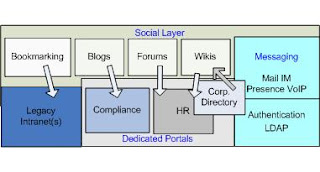
As a result I decided to try to represent, in diagram form, my vision of this integration of old with new:
As a result I decided to try to represent, in diagram form, my vision of this integration of old with new:

The new social tools are used by the workforce community to talk sometimes, about content that can be found within the legacy intranet(s) and within the dedicated (specialist) portals. Also, documents bound eventually for these “locked-down” dedicated portals might start life as a collaboratively authored document within the wiki.
In the opposite direction, basic workforce information flows from the formal HR systems to form the skeletal person pages within the wiki. The employee can then embellish these with the more social/transient sections (languages I speak, web sites(or intranet pages!) I find interesting, projects I am working on)
Luis goes on: “The key towards a successful implementation and deployment of social computing tools behind the corporate firewall is not going to be on the substitution of already existing collaborative tools, but in the integration, consolidation and augmentation of what is already available”
In my book, the definition of Web 2.0 is user-created content. If a social book- marking tool can be deployed over the top of the legacy intranets then users (the workforce) will use it to decide to reinvigorate the parts of the legacy intranet that the crowd judges to be still useful/relevant, by linking to it.
“by providing different ways on how those same tools would merge and integrate with the collaboration and knowledge sharing flow of what is already available”
As Dennis Howlett put it last week:
“There is no requirement to ditch incumbent applications that continue to deliver value"
A big thank you to Luis for so eloquently wording what must be our shared vision and also for his kind words about my contribution.
Comments?
In the opposite direction, basic workforce information flows from the formal HR systems to form the skeletal person pages within the wiki. The employee can then embellish these with the more social/transient sections (languages I speak, web sites(or intranet pages!) I find interesting, projects I am working on)
Luis goes on: “The key towards a successful implementation and deployment of social computing tools behind the corporate firewall is not going to be on the substitution of already existing collaborative tools, but in the integration, consolidation and augmentation of what is already available”
In my book, the definition of Web 2.0 is user-created content. If a social book- marking tool can be deployed over the top of the legacy intranets then users (the workforce) will use it to decide to reinvigorate the parts of the legacy intranet that the crowd judges to be still useful/relevant, by linking to it.
“by providing different ways on how those same tools would merge and integrate with the collaboration and knowledge sharing flow of what is already available”
As Dennis Howlett put it last week:
“There is no requirement to ditch incumbent applications that continue to deliver value"
A big thank you to Luis for so eloquently wording what must be our shared vision and also for his kind words about my contribution.
Comments?
Sunday, August 19, 2007
Dennis Howlett’s post Old meets new: Lotus Domino and Atlassian seems to have generated new interest in DominoWiki the excellent open source wiki by Ben Pool. I even saw a question on Ben’s blog from IBM’s Domino head honcho: Ed Brill! The question is: why did the project outgrow DominoWiki?
This caused me to return to earlier thoughts regarding what makes a wiki enterprise strength?
When I spoke to Ben at Lotusphere Comes To You early this year I outlined some of the bespoke changes we were making to the product. It became clear that some of these features were being looked at for inclusion in the core project, probably for V1.2 (I fully emphasize with the brand of open source developer who have to feed their families by way of day gigs while pursuing the development of the project by night. This inevitably makes for a slow rate of progress)
I needed some improvements quickly. These are the features I decided were needed in order promote interest and make the product highly usable within the enterprise:
Tag cloud: I noticed that the Categories function built-in to DominoWiki worked rather like tags. I renamed them to tags and had a tag cloud built.
This caused me to return to earlier thoughts regarding what makes a wiki enterprise strength?
When I spoke to Ben at Lotusphere Comes To You early this year I outlined some of the bespoke changes we were making to the product. It became clear that some of these features were being looked at for inclusion in the core project, probably for V1.2 (I fully emphasize with the brand of open source developer who have to feed their families by way of day gigs while pursuing the development of the project by night. This inevitably makes for a slow rate of progress)
I needed some improvements quickly. These are the features I decided were needed in order promote interest and make the product highly usable within the enterprise:
Tag cloud: I noticed that the Categories function built-in to DominoWiki worked rather like tags. I renamed them to tags and had a tag cloud built.
Pages by tags view – users using the tags. I feel the process of discovering others who are using the same tag(s) is key.
All tags used by a user view - Discover other stuff that like minded users are writing.
Auto image tag insert One thing that caused a lot of confusion - "I uploaded an image but it does not show up on the page".
Improved tagging process - Existing tags (categories) were lost if one selected a new one. I combined a check-box system by which users had to uncheck a tag to remove it. Combined with the list of all tags in the wiki to select from and the field into which new tags could be entered (multiple tags separated by commas)
Many pages of help & advice - I composed many instructional pages to guide the new user.
Colour text markup
Alt-text markup for non CamelCase page name links - I could not see how to display text for a link that was not the page name
Things I am considering adding in the near future:
email-in - Any Domino user will know that the platform lends itself to this. This is a killer feature for any wiki as it allows reluctant users to compose within an editor they are familiar with. It also allows those on mobile email devices or within web cafe to utilise a spare moment to log an inspirational thought.
email Alerts
Granular RSS - down to page (and its children) level (RSS is a major component of Enterprise 2.0)
Delete Page Improvements - Giving consideration to history
Advanced Tag Cloud - Related Tags View, 20 most popular only etc.
"Newsworthy” checkbox - push a link to the homepage,
Permissioned Areas, - A major requirement for Enterprise
Rich-Text Editor
Printer Friendly facility
Atlassian, as a result of a presumably huge investment has given all of these features (and more) to Confluence in its out-of-the box form and the enterprise licensing costs are very competitive.
Despite this the DominoWiki based wikis (I now employ three) continue to provide real value and in my opinion have enormous potential.
Subscribe to:
Posts (Atom)